
Aston Martin Valhalla: Everything You Need to Know About the Hybrid Supercar
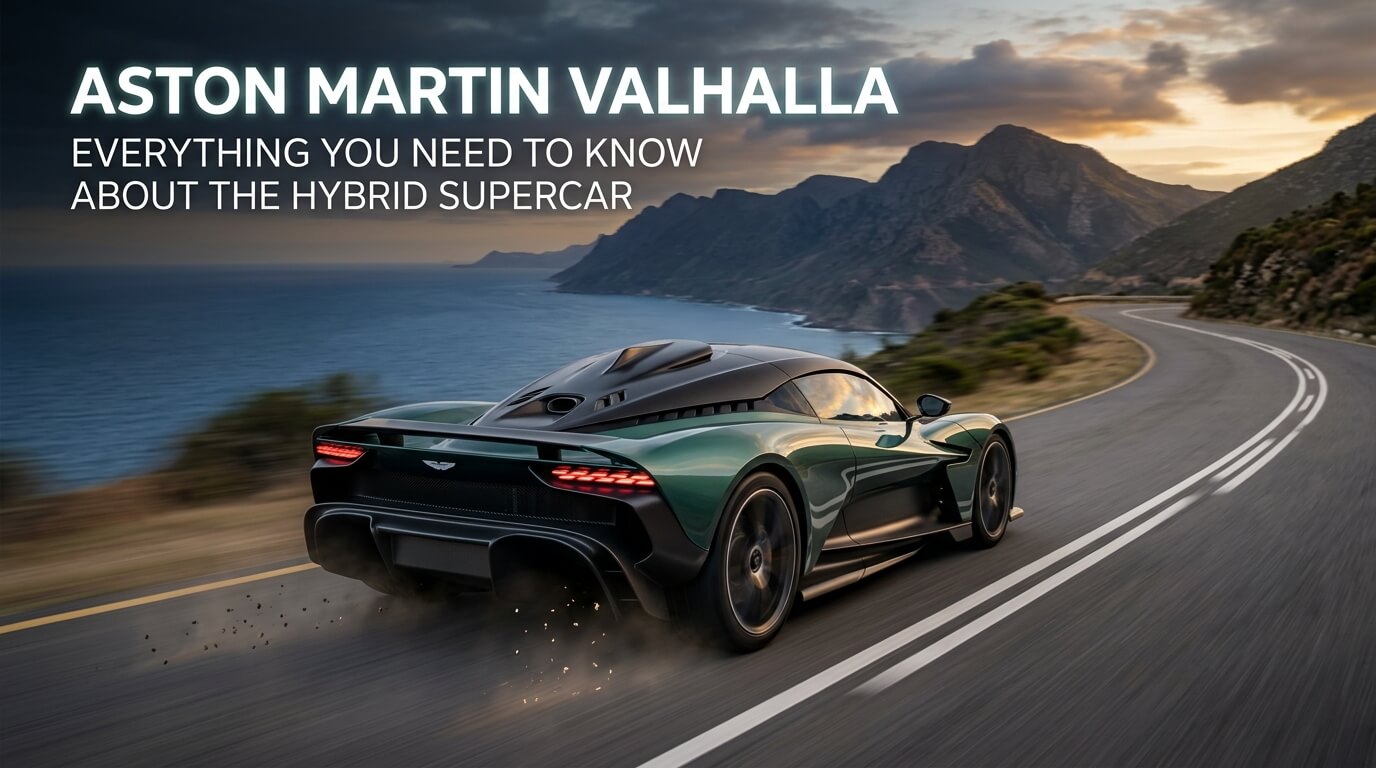

Introduction: The British Hybrid Revolution
After years of anticipation, Aston Martin has finally unleashed its most technologically advanced series-production model yet: the Valhalla. This isn’t just another supercar. It represents a seismic shift for the iconic British brand, moving away from its traditional front-engine layout to embrace a mid-engine, plug-in hybrid future inspired directly by Formula 1.
With a price tag that sits in a unique space between supercar and hypercar, the Valhalla promises staggering performance figures wrapped in breathtaking design. Named after the great hall of fallen warriors in Norse mythology, the Valhalla is built to conquer both road and track.
Here is everything you need to know about the 2026 Aston Martin Valhalla.
The Aston Martin Valhalla occupies an intriguing market position. It is priced above entry-level hybrid supercars like the Ferrari SF90 and Lamborghini Revuelto but offers a level of exclusivity and technology that rivals significantly more expensive hypercars.
| Market | Price (Base) | Notes |
|---|---|---|
| United Kingdom | £850,000 | Includes VAT |
| United States | $1,050,000 | Approximate, before options |
| China | 10.688 million RMB | Deliveries starting Q2 2026 |
| Europe | €980,000 | Varies by country |
When discussing rivals, the Valhalla directly competes with:
Aston Martin positions the Valhalla as a “value” alternative to the stratospheric Ferrari F80, offering comparable performance for roughly one-quarter of the price.
The heart of the Valhalla is a complex and powerful plug-in hybrid system that represents Aston Martin’s first foray into electrified supercar production. After initially planning a V6 engine, Aston Martin switched to a V8 for greater power and reliability.
| Component | Specification |
|---|---|
| Combined Power | 1,064 bhp (1,079 PS) |
| Combined Torque | 811 lb-ft (1,100 Nm) |
| Engine Type | 4.0-liter twin-turbo V8 with flat-plane crank |
| Engine Power (alone) | 817 bhp |
| Electric Motors | Three total (two front axle, one rear transmission) |
| Electric Power | 247 bhp combined |
| Transmission | 8-speed dual-clutch (DCT) with no reverse gear |
| Battery Capacity | 8.0 kWh lithium-ion |
| Electric Range | 8 to 9 miles (WLTP) |
The internal combustion engine alone produces 817 bhp, making it the most powerful V8 ever fitted to an Aston Martin. The engine is sourced from Mercedes-AMG but has been heavily reworked by Aston Martin’s engineers with a unique flat-plane crankshaft, new turbochargers, and a bespoke exhaust system.
The trio of electric motors adds a further 247 bhp, filling in torque gaps and providing instant response. The system utilizes “torque filling” technology, where the electric motors provide propulsion while the turbochargers spool up, completely eliminating traditional turbo lag.
Unique Feature: The Valhalla has no reverse gear in its transmission. Reverse is handled entirely by the two front electric motors, saving weight and complexity.
To manage this immense power, Aston Martin developed an all-new carbon fiber structure from the ground up. The Valhalla is built around a custom carbon fiber monocoque (central tub) that weighs just 74 kilograms (163 pounds).
The suspension setup is a radical departure for Aston Martin. By mounting the springs and dampers inboard (inside the chassis rails rather than at the wheel hubs), unsprung mass is reduced. This means the wheels can react to road surfaces much faster, improving both ride comfort and cornering grip. This technology is a direct transfer from the Aston Martin Aramco Formula 1 team.
The carbon-ceramic brakes are massive by supercar standards. The 410mm front discs are larger than those found on most hypercars. Aston Martin claims a 60-0 mph stopping distance of just 98 feet (30 meters), which is exceptional for a car weighing nearly 4,000 pounds.
If the engine is the heart, the aerodynamics are the soul of the Valhalla. Utilizing lessons learned from the track-only Valkyrie and Aston Martin’s Formula 1 program, the Valhalla features an intricate active aero system that allows it to corner with supercar-crushing grip.
| Component | Specification |
|---|---|
| Max Downforce | 600 kg (1,323 lbs) at 150 mph |
| Active Front Splitter | Hydraulically deployed, hidden under nose |
| Active Rear Wing | Hydraulic, rises 255mm in Race mode |
| Underbody Tunnels | Venturi tunnels for ground effect |
| DRS Function | Yes – rear wing flattens at high speed |
| Airbrake Function | Yes – rear wing deploys vertically under braking |
The Valhalla features a Drag Reduction System (DRS) similar to Formula 1 cars. At high speeds on straights, the rear wing flattens out to reduce drag, allowing the Valhalla to hit its top speed of 217 mph. At maximum braking, the rear wing deploys vertically to act as a massive air brake, significantly reducing stopping distances.
The underbody Venturi tunnels are a ground-effect feature banned from F1 but perfectly legal on road cars. As the car moves, air accelerates through these tunnels, creating low pressure under the car and literally sucking it onto the road surface.
Driver Modes: The aero system adapts automatically based on drive mode selection: GT, Sport, Race, and EV. Race mode delivers maximum downforce for track driving.
Inside, the Valhalla is a study in minimalist, driver-focused aggression, but with a surprising level of comfort compared to the hardcore track-only Valkyrie.
The Big Concession: There is no boot. No front trunk (frunk). Zero storage for luggage. While the ride is comfortable enough for long road trips, Aston Martin completely omitted storage space, a mistake that rivals like Ferrari and Lamborghini have learned to avoid. However, there are cupholders and door pockets for small items like phones and wallets.
The low seating position provides excellent forward visibility, but rear visibility is severely compromised due to the mid-engine layout and large rear wing. Aston Martin includes a rear-view camera system that displays on the central screen to compensate.
Early reviews of the Valhalla prototype (with final hardware but approximately 85 percent final software) indicate a car that prioritizes balance and usability over sheer intimidation.
| Metric | Value |
|---|---|
| 0 to 62 mph (0 to 100 km/h) | 2.5 seconds |
| 0 to 124 mph (0 to 200 km/h) | 6.8 seconds |
| 0 to 186 mph (0 to 300 km/h) | 16.5 seconds |
| Top Speed | 217 mph (electronically limited) |
| Quarter Mile | 9.9 seconds at 148 mph |
| Electric Only Top Speed | 80 mph |
| Nurburgring Lap Time (estimated) | 6 minutes 45 seconds |
Journalists from Top Gear and evo magazine note that the Valhalla feels less aggressive and twitchy than the Ferrari SF90. The chassis allows for a bit of body roll, which actually helps the driver feel the car’s weight transfer, making it “playful” and “easy to skid” rather than clinical and cold.
The steering is described as precise but not overly heavy, with excellent feedback through the wheel. The pushrod suspension absorbs bumps surprisingly well, making the Valhalla more comfortable on public roads than expected.
The engine note has received mixed reviews. Due to the flat-plane crankshaft, it lacks the deep guttural roar of traditional American V8s and sounds more like a high-strung V6. However, it revs eagerly to 7,200 rpm and produces a distinctive howl at high revolutions.
The Valhalla is a plug-in hybrid (PHEV), meaning it can be charged via an external cable or through regenerative braking. The 8.0 kWh battery pack is located low in the chassis for optimal weight distribution.
The Valhalla offers four distinct drive modes that adjust powertrain response, suspension, and aerodynamics:
Official fuel economy figures are not yet finalized, but Aston Martin estimates approximately 35 miles per gallon (combined) when the battery is charged, dropping to 18 mpg when running on engine alone.
The Valhalla’s design is unmistakably Aston Martin while being entirely new. Design cues include the iconic front grille shape, but the overall proportions are dramatically different from any previous Aston.
Aston Martin offers the Valhalla in a curated palette of eight colors, with unlimited bespoke options through its Q personalization service:
Like the Valkyrie, the Valhalla features dihedral doors that open upward and forward. This design not only looks dramatic but also makes entry and exit easier in tight parking spaces compared to traditional scissor or butterfly doors.
For buyers considering the Aston Martin Valhalla, here is how it stacks up against its primary competitors.
| Specification | Aston Martin Valhalla | Ferrari SF90 XX Stradale | Lamborghini Revuelto |
|---|---|---|---|
| Power | 1,064 bhp | 1,016 bhp | 1,001 bhp |
| 0-62 mph | 2.5 seconds | 2.3 seconds | 2.5 seconds |
| Top Speed | 217 mph | 199 mph | 217 mph |
| Drivetrain | All-wheel drive | All-wheel drive | All-wheel drive |
| Engine | 4.0L V8 twin-turbo | 4.0L V8 twin-turbo | 6.5L V12 naturally aspirated |
| Electric Range | 8 miles | 15 miles | 6 miles |
| Price | $1.05 million | $830,000 | $608,000 |
Verdict: The Valhalla is more expensive than both rivals but offers exclusive production numbers (999 units vs thousands for Ferrari and Lamborghini). The V12 Lamborghini wins on sound, while the Ferrari wins on electric range. The Valhalla wins on pure aerodynamic sophistication.
A: The Valhalla starts at £850,000 in the UK, approximately $1.05 million in the US, and 10.688 million RMB in China. These prices exclude options and dealer fees.
A: Yes, the Valhalla is fully street legal in all major markets including the US, UK, Europe, and China. It includes all required safety and emissions equipment.
A: Only 999 examples will be produced worldwide, making it a highly exclusive collector’s car.
A: A 4.0-liter twin-turbo V8 with a flat-plane crankshaft. The engine is based on a Mercedes-AMG unit but heavily modified by Aston Martin.
A: The Valhalla has slightly more power (1,064 bhp vs 1,016 bhp), but the Ferrari is quicker to 60 mph (2.3 seconds vs 2.5 seconds). Top speeds are nearly identical.
A: No. The Valhalla has no front trunk or rear boot. There are only small interior storage spaces for phones and wallets.
A: Deliveries begin in the second half of 2025 for UK and US customers. Chinese customers will receive their cars in Q2 2026.
A: Yes, it is a plug-in hybrid (PHEV) with three electric motors and an 8.0 kWh battery. It can drive on electric power alone for up to 9 miles.
Q: How much downforce does the Valhalla produce?
A: The Valhalla produces 600 kg (1,323 lbs) of downforce at 150 mph, which is exceptional for a road-legal car.
Q: What is the top speed of the Aston Martin Valhalla?
A: The top speed is electronically limited to 217 mph (350 km/h).
The Aston Martin Valhalla is not just a car; it is a statement of intent. After years of delays and a switch from a V6 to a V8, the final product appears to be worth the wait. It bridges the gap between the insane, track-focused Valkyrie and the grand touring nature of the DB12.
While the lack of luggage space and the high price (over $1 million) are significant hurdles for daily use, the Valhalla offers a unique blend of Formula 1-derived active aero, a thrilling hybrid powertrain, and a chassis that prioritizes driver enjoyment over raw lap times.
For the 999 lucky buyers who secured an allocation, this is the dawn of a new era for Aston Martin. The Valhalla proves that the British brand can compete with and even surpass Italian rivals in the hybrid supercar space.
If you have the means and the opportunity, the Valhalla is one of the most exciting supercars of the decade. Drive safe, and enjoy every one of its 1,064 horses.