
UK Registers Its 2 Millionth Electric Car: What the Milestone Means for EV Adoption
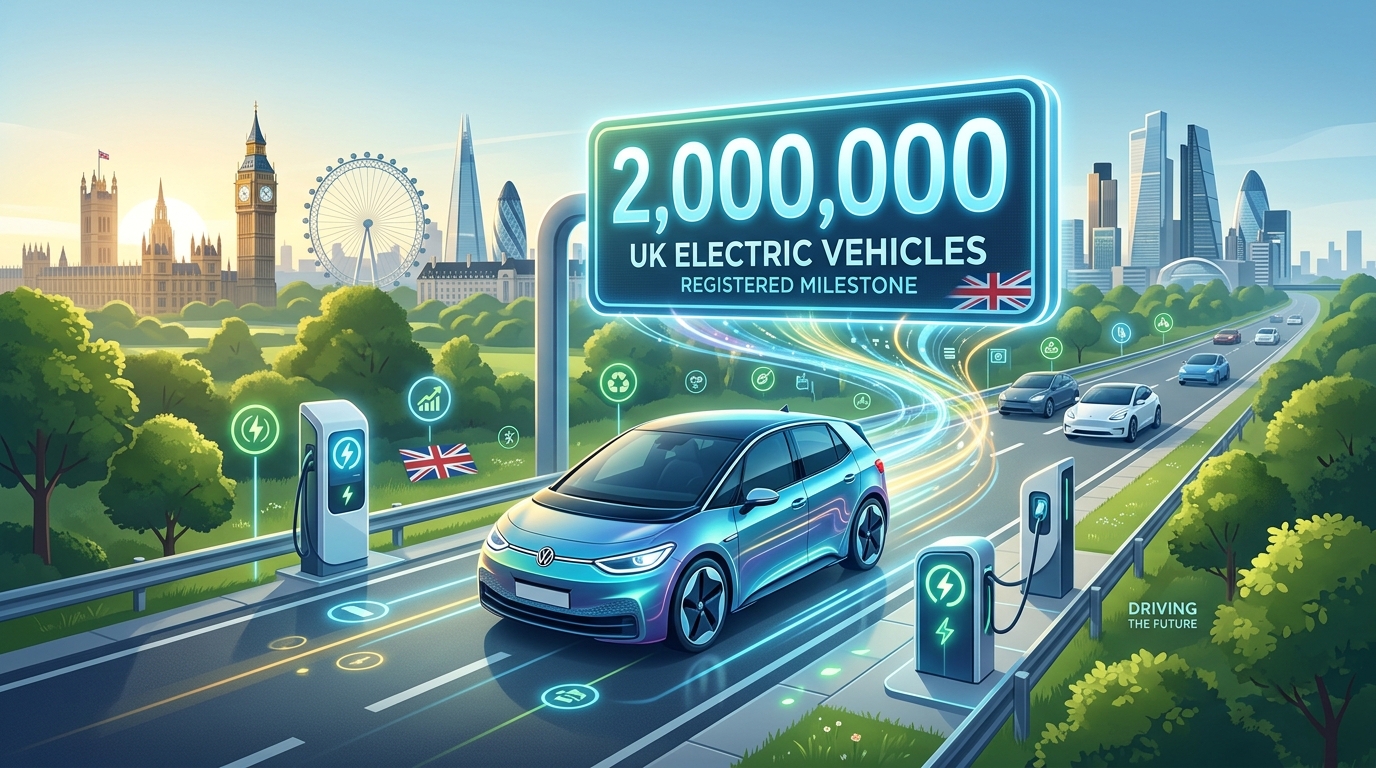

A landmark moment for British motoring arrived in April 2026. For the first time in history, the number of battery electric vehicles (BEVs) on UK roads surpassed two million.
According to data from the Department for Transport (DfT) and the Society of Motor Manufacturers and Traders (SMMT), there were 2,012,758 zero-emission vehicles licensed for use in the UK as of April 2026. This milestone marks a seismic shift in how Britons drive—and it has happened far faster than almost anyone predicted.
It took roughly 14 years for the UK to register its first million electric cars. The second million took just over two years.
Transport Secretary Heidi Alexander hailed the news as a “landmark moment” in the UK’s transition to electric motoring, adding: “As global fuel prices continue to fluctuate, making the switch has never made more sense.”
But beneath the celebration lies a more complex reality. While two million EVs is a remarkable achievement, the UK is still falling significantly short of the government’s own legally mandated targets for new car sales.
This article breaks down how the UK hit two million EVs, what it means for drivers, and whether the momentum can be sustained.
Related Reading: If you are considering switching to an electric car, understanding the financial landscape is crucial. Read our guide on the FCA Car Finance Compensation Scheme and whether you could claim if you have been overcharged on a previous finance agreement.
The journey to two million EVs has been defined by accelerating growth. Data from the SMMT shows that the rate of EV adoption has more than doubled in recent years.
| Milestone | Date Reached | Time Taken |
|---|---|---|
| 1 million EVs | January 2024 | ~14 years |
| 2 million EVs | April 2026 | ~2 years 3 months |
According to RAC senior policy officer Rod Dennis: *“It took around 14 years for a million battery-electric vehicles to be on UK roads, so for this figure to double in just a further two is impressive.”*
Several factors have combined to accelerate EV adoption to this pace:
The government reintroduced the Electric Car Grant in 2025, offering up to £3,750 off the purchase price of a new EV that meets specific criteria (purchase price below £50,000). The DfT has credited this scheme as a key factor in driving continued growth.
The ongoing Iran conflict has caused global fuel prices to spike. As Transport Secretary Alexander noted, volatile fuel prices have made the running cost advantage of EVs increasingly compelling.
The EV market is no longer dominated by premium models like Teslas. Affordable options from Chinese brands like BYD and MG, alongside traditional manufacturers ramping up production, have brought EVs into mainstream price brackets. In April 2026 alone, BYD sales doubled to 5,059 vehicles.
April 2026 saw BEV registrations surge 59.1% compared to the same month in 2025, taking a 26.2% market share—the best performance in a typically low-volume month.
Beyond the headline number, the two million EV milestone has practical implications for every driver—whether you already own an electric car or are still considering the switch.
With two million EVs on the road, a healthy used electric car market is now emerging. Prices for second-hand EVs have become more competitive, making the switch accessible to a wider range of buyers. The RAC noted that “wider availability… on the used car market” is a key driver of continued adoption.
More EVs on the road creates a virtuous cycle: it justifies further investment in public charging infrastructure. As of January 2026, there were 116,052 public EV chargers across the UK, with 13,281 added in the past year alone.
The government has also committed substantial funding through schemes like the Local Electric Vehicle Infrastructure (LEVI) fund. For example, the Isle of Wight recently secured a contract to install over 1,500 new chargepoints specifically for residents without off-street parking.
As production scales up, battery costs continue to fall. This is reflected in lower list prices for new EVs and more attractive leasing and PCP deals. However, as the SMMT notes, “energy, production and charging costs remain high,” keeping some buyers on the sidelines.
Smart Buying Advice: Whether you are buying new or used, a thorough vehicle check is essential. Learn how to check a used car before buying to avoid costly mistakes.
Semantic Keywords: used electric car prices, EV charging infrastructure UK, public charge points, battery cost reduction, EV affordability
Despite the jubilation surrounding two million EVs, the industry faces a sobering reality: the pace of new EV sales is still not fast enough to meet the government’s Zero Emission Vehicle (ZEV) Mandate targets.
The ZEV Mandate requires that 33% of all new car registrations in 2026 be zero-emission vehicles (BEVs). However, year-to-date figures show BEVs at just 23.1% of the market—well below the target.
| Metric | Value |
|---|---|
| 2026 ZEV Mandate Target | 33% |
| Year-to-Date BEV Share (April 2026) | 23.1% |
| SMMT Forecast BEV Share (Full Year 2026) | 26.8% |
| Shortfall vs. Target | ~6 percentage points |
The SMMT has actually downgraded its 2026 BEV share forecast from 28.5% to 26.8%, citing a weaker-than-expected first quarter. Even the strong April performance (26.2% BEV share) was insufficient to close the gap.
According to the SMMT and industry analysts, several barriers remain:
Mike Hawes, SMMT Chief Executive, warned:
“Two million electric car registrations is a considerable milestone to celebrate, although natural demand is still well below the level demanded by the mandate. The mounting cost of compliance threatens to limit consumer choice, overall decarbonisation and the sector’s competitiveness.”
Semantic Keywords: ZEV Mandate gap, EV sales targets UK, mandate compliance, SMMT forecast, EV demand barriers, VED changes 2026
For the transition to continue beyond two million EVs, charging infrastructure must keep pace. The latest government statistics paint a picture of progress—and persistent regional inequality.
| Region | EV Chargers per 100,000 | Rapid+ Chargers per 100,000 |
|---|---|---|
| London | 338.1 | 25.6 |
| Scotland | 217.5 | 53.8 |
| South West | 148.0 | 45.7 |
| Northern Ireland | 57.5 | 16.7 |
London leads in total chargers per capita but has the second-lowest proportion of rapid chargers, reflecting its reliance on slower on-street charging for residents without driveways. Scotland, by contrast, has the highest density of rapid chargers, supporting longer journeys across rural areas.
Critically, the urban-rural divide is less pronounced than feared. As of January 2026, 17.1% of EV chargers were in rural areas, closely matching the 17.5% of the population that lives rurally. This suggests infrastructure rollout is broadly keeping pace with population distribution.
Sophie Linnell, Infrastructure and Energy Director at Walker Morris, noted:
“This is increasingly an infrastructure-led challenge. Limited access to reliable charging, particularly for long-distance travel, alongside delays in securing grid connections, continue to deter both consumers and fleet operators.”
Grant scheme data reveals where EV adoption is concentrated. The Electric Vehicle Chargepoint Grant (EVCG) , which funds home charging for renters and flat owners, has supported significant growth across the UK.
| User Type | Sockets Installed | Percentage |
|---|---|---|
| Renters and flat owners | 21,754 | 67% |
| Car parks (residential/staff/fleet) | 8,658 | 27% |
| Landlords | 2,039 | 6% |
The dominance of renters and flat owners in these statistics is significant: it demonstrates that the two million EV milestone is not just for homeowners with driveways. Increasingly, those without off-street parking are making the switch, supported by on-street and workplace charging solutions.
The Workplace Charging Scheme (WCS) has funded 67,290 sockets in workplace carparks since 2016, with the South East, North West, and East of England leading the way.
The SMMT has upgraded its overall 2026 new car market forecast to 2.093 million registrations (up 3.6% from 2025). However, it has cut its EV share forecast to 26.8%.
| Year | Total Registrations | Forecast BEV Share |
|---|---|---|
| 2026 | 2.093 million | 26.8% |
| 2027 | 2.121 million | 32.0% |
Even the 2027 forecast of 32% BEV share still falls six percentage points short of that year’s ZEV Mandate target.
1. The Iran War and Energy Prices
The ongoing conflict in Iran adds significant uncertainty. While rising petrol prices make EVs more attractive, higher energy costs also increase the cost of public charging. The SMMT noted that “rising interest in EVs could be tempered by concern over inflation, higher energy prices and the resultant negative impact on the cost of living.”
2. The 3p-Per-Mile Tax
Chancellor Rachel Reeves has announced a 3p-per-mile pay-per-mile tax for EVs, effective April 2028. Trade groups have warned that this could cost the Exchequer up to £4.8 billion if drivers delay switching. The impact of this announcement on current buying decisions remains unclear.
In March 2026, the government confirmed it is reviewing the ZEV Mandate following the biggest car production fall in 73 years. Any changes to the mandate—whether softening targets or introducing new incentives—could dramatically alter the trajectory to three million EVs.
Worth Knowing: If you are planning to sell your current petrol or diesel car to make way for an EV, getting the best price matters. Check out essential tips for selling your car faster online to maximise your sale.
The two million electric car milestone is genuinely worth celebrating. It represents billions in private and public investment, significant CO2 reduction, and a fundamental shift in consumer behaviour.
Ben Nelmes, CEO of New AutoMotive, put it bluntly:
“It’s no wonder there are 2 million electric cars on our roads – they are cheaper than petrol and there’s never been more choice. April’s surge in EV demand proves that the ZEV Mandate is working. We are seeing a massive decoupling: the car market is growing, yet petrol and diesel sales are shrinking. For car manufacturers, the lesson is clear: if you aren’t building electric, you’re building history.”
But the industry faces genuine headwinds. The gap between EV sales and the ZEV Mandate is widening. The cost of compliance—billions in manufacturer discounts—is unsustainable. And infrastructure, while improving, remains patchy.
The next two million EVs will be harder than the first two million. They will require reaching drivers without driveways, in rural areas, and on tighter budgets. Whether the UK can hit three million by 2028 depends entirely on the policy decisions made in the coming months.
The registration of the 2 millionth electric car in the UK is a landmark moment for British motoring. It proves that the transition away from petrol and diesel is not a fringe movement but a mainstream reality.
For drivers, the milestone means:
But for policymakers, the message is clear: the current pace is still not enough. Without addressing the cost of public charging, the looming pay-per-mile tax, and regional infrastructure gaps, the road to three million EVs will be far bumpier than the road to two million.
As Mike Hawes warned, Britain’s attractiveness as a vehicle market and manufacturing hub is at risk if the mandate is not aligned with market realities.
For now, however, two million is a number worth celebrating. It means that somewhere on a street near you, there are more electric cars than ever before—and that number is growing every day.
Disclaimer: This article is for informational purposes only and does not constitute financial or investment advice. EV registration figures are subject to revision by the SMMT and DfT. Always conduct independent research before making a vehicle purchase decision.
A: The milestone was reached in April 2026, according to SMMT data. There were 2,012,758 battery electric vehicles licensed for use on UK roads as of that date.
A: Approximately 2 years and 3 months. The first million took around 14 years, highlighting how rapidly EV adoption has accelerated.
A: In April 2026, 26.2% of new car registrations were battery electric vehicles (BEVs). Year-to-date, BEVs account for 23.1% of the market.
A: No. The 2026 ZEV Mandate target is 33% BEV share, but current year-to-date figures are 23.1%. The SMMT has downgraded its full-year forecast to 26.8%.
A: As of January 2026, there were 116,052 public EV chargers across the UK, with 13,281 added in the past year.
A: Official statistics are published by the Department for Transport (DfT) and the Society of Motor Manufacturers and Traders (SMMT) .
A: With manufacturer discounts, the Electric Car Grant (up to £3,750), and high petrol prices, many drivers find EVs financially attractive. However, consider your access to charging and the upcoming 3p-per-mile tax from 2028.