
UK New Car Registrations June 2026: Latest Sales Figures and Market Trends
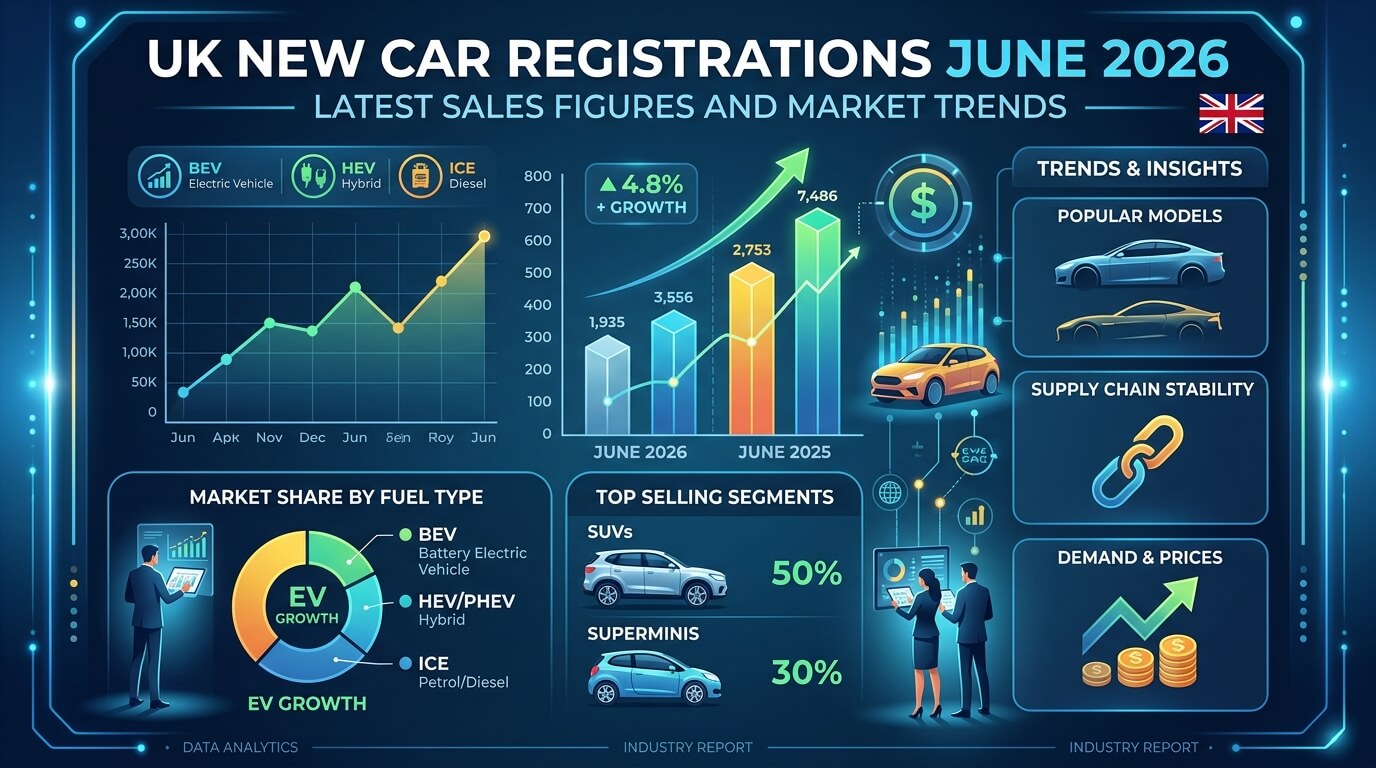

The UK new car market continued its recovery in June 2026, posting a second consecutive month of growth and marking the strongest June for new car registrations since 2019. But beneath the headline numbers lies a more complex story—one of surging electric vehicle adoption, missed government targets, and growing tensions between automakers and policymakers.
According to the Society of Motor Manufacturers and Traders (SMMT) , the UK’s new car market grew by 6.7% in June , with 191,316 new vehicles registered during the month. This brings the total for the first half of 2026 to approximately 1.09 million units , putting the market on track to break the 2 million barrier for the first time since before the pandemic.
But while overall volumes are rising, the industry is facing a fundamental challenge: drivers aren’t buying enough zero-emission vehicles to meet the government’s mandated targets.
This article breaks down the June 2026 registration figures, analyses the key trends driving the market, and explains what the numbers mean for car buyers, manufacturers, and the UK’s net-zero ambitions.
Related Reading: The shift to electric vehicles is happening alongside major changes in how Britons buy and sell cars. If you are planning to sell your current petrol or diesel car before switching to an EV, read our guide on where you can sell your car in the UK quickly and safely.
The June 2026 data, published by the SMMT, shows a healthy market recovery:
| Metric | June 2026 Figure | Change vs June 2025 |
|---|---|---|
| Total New Car Registrations | 191,316 | +6.7% |
| Best June since | 2019 | — |
| Year-to-Date Total (Jan-June) | ~1.09 million | +3.4% |
The June performance follows a strong April, which saw registrations jump 24% year-on-year to 149,247 units. The SMMT has subsequently upgraded its full-year 2026 forecast to nearly 2.1 million units , up from an earlier projection of 2.048 million.
However, industry analysts caution that this growth is built on “fragile foundations.” Philip Nothard , Insight & Strategy Director at Cox Automotive, noted:
*“The rise to 2.02 million registrations highlights a gradual recovery in the market, but this is built on fragile foundations. Heavy reliance on EV-led growth suggests underlying demand remains weaker than the totals imply.”*
The standout story of June 2026 was the continued surge in Battery Electric Vehicle (BEV) adoption. According to the SMMT data, 47,354 BEVs were registered in June, representing a 39% jump compared to June 2025.
| Fuel Type | June 2026 Market Share | Change vs June 2025 |
|---|---|---|
| Battery Electric Vehicle (BEV) | 24.8% | +39% |
| Plug-in Hybrid (PHEV) | 11.0% | +29% |
| Petrol | Declined | -4% |
| Full Hybrid (HEV) | Declined | -8.5% |
| Diesel | Static | No change |
Combined, electric vehicles (BEV + PHEV) accounted for 35.8% of all new car registrations in June. However, petrol and diesel vehicles still made up 52% of registrations across the first half of the year.
Mike Hawes , SMMT Chief Executive, commented:
“A second consecutive month of growth for the new car market is good news, as is the positive performance of EVs. That EV growth, however, is still being driven by substantial industry support with manufacturers using every channel and unsustainable discounting to drive activity, yet it remains below mandated levels.”
Worth Knowing: If you are considering buying an electric vehicle, understanding the different models available is crucial. Read our detailed review of the Leapmotor C10 EV to see how one of the newest Chinese EV entrants performs in the UK market.
Semantic Keywords: battery electric vehicles, BEV registrations, plug-in hybrid sales, EV market share UK, electric car adoption, zero-emission vehicles, charging infrastructure, manufacturer discounts
Despite the impressive growth in EV sales, the industry remains significantly short of the government’s Zero Emission Vehicle (ZEV) Mandate targets.
Under the ZEV Mandate, 28% of new car registrations in 2026 were supposed to be zero-emission vehicles (BEVs). However, half-year data shows BEVs at just 21.6% market share —well below the target. June’s 24.8% was an improvement, but not enough to close the gap.
| Year | ZEV Mandate Target | Forecast BEV Share | Shortfall |
|---|---|---|---|
| 2026 | 28% | 26.8% (SMMT forecast) | ~1.2 percentage points |
| 2027 | 33% | 32% (SMMT forecast) | ~6 percentage points |
The SMMT has downgraded its 2026 BEV share forecast to 26.8% , down from an earlier 28.5% projection, following a softer-than-expected first quarter.
Giacomo Margiotta-Mills , Industry Director at Dassault Systèmes, warned:
“Reaching two million electric cars on UK roads is a genuine milestone—but the SMMT’s own data tells us the harder truth: demand is still falling well short of what the mandate requires. The industry cannot close that gap through ambition alone.”
Semantic Keywords: *ZEV Mandate, zero-emission vehicle targets, BEV mandate shortfall, SMMT forecast 2026, government EV targets, compliance penalties, manufacturer obligations*
If EVs are better for the environment and cheaper to run, why aren’t more drivers buying them? Industry experts point to several key barriers.
Despite falling battery prices, electric cars remain more expensive to purchase than their petrol or diesel equivalents. While the government reintroduced the Electric Car Grant in 2025, the SMMT argues this isn’t enough.
The SMMT has called for:
The industry body estimates that these measures would put an additional 267,000 BEVs on the road over three years, cutting CO2 emissions by six million tonnes per year.
Range anxiety remains a real concern for many drivers. While public charging infrastructure is improving, the rollout has been uneven, with significant gaps in rural areas and for those without off-street parking.
April 2026 saw changes to Vehicle Excise Duty (VED) that, according to the SMMT, act as “fiscal disincentives” to EV adoption. EVs are no longer exempt from the expensive car supplement, adding hundreds of pounds to the first-year tax bill for many electric models.
With inflation and energy costs remaining high, many households are prioritising lower upfront costs over long-term fuel savings. As Finimize reported:
“Higher living costs and expensive electricity can slow that shift even when gasoline prices rise. If targets run ahead of what people can afford, policymakers face a trade-off: tighten the screws and risk backlash, or adjust incentives and timelines to keep the transition moving.”
Related Reading: The future of automotive trading is being reshaped by digital platforms and AI. Discover how digital platforms and artificial intelligence are transforming the car buying and selling experience in our latest industry analysis.
Despite the challenges, the overall outlook for the UK new car market is positive. Several organisations have published their forecasts:
| Year | Total Registrations | BEV Share |
|---|---|---|
| 2026 | 2.093 million (+3.6%) | 26.8% |
| 2027 | 2.121 million | 32.0% |
Source: SMMT
| Scenario | 2026 Registrations | Year-on-Year Change |
|---|---|---|
| Upside | 2.23 million | +10.4% |
| Baseline | 2.08 million | +2.9% |
| Downside | 1.89 million | -6.4% |
Source: Cox Automotive
The baseline scenario of 2.08 million units aligns closely with the SMMT’s upgraded forecast, suggesting broad industry consensus on modest but steady growth.
Mike Hawes called for a review of the green transition:
“The mounting cost of compliance threatens to limit consumer choice, overall decarbonisation and the sector’s competitiveness. This could hurt Britain’s attractiveness as a vehicle market and manufacturing hub.”
Semantic Keywords: UK car market forecast 2026, SMMT outlook, Cox Automotive baseline scenario, 2027 BEV projections, automotive industry growth, manufacturing competitiveness
If you are in the market for a new car in 2026, the current trends have several implications for you.
Because manufacturers are struggling to meet ZEV Mandate targets, they are aggressively discounting electric vehicles. The SMMT itself noted that EV growth is being driven by “substantial industry support” and “unsustainable discounting.”
This means:
However, this cannot last forever. If the government adjusts the mandate or introduces new incentives, discounts may shrink.
With petrol and diesel still accounting for over half of new registrations, the internal combustion engine is far from dead. However, manufacturers are reducing model lines and focusing investment on EVs. If you want a specific petrol model, availability may become more limited over time.
Used EV values have been volatile. While new EV discounts are attractive, be aware that rapid depreciation could affect your vehicle’s residual value. For PCP finance customers, this could impact your final “balloon payment” and negative equity.
Important: If you are selling your current car to make way for a new EV, knowing where to sell can make a significant difference to your sale price. Check out our city-specific guides, such as where to sell your car in Perth, where to sell your car in Cardiff, and where to sell your car in Belfast for local advice.
Semantic Keywords: EV discounts UK, manufacturer deposit contributions, PCP finance deals, EV depreciation, residual values, negative equity, petrol model availability
The UK’s EV transition is happening against a backdrop of global trends. Notably, China’s BYD and other Chinese brands are expanding rapidly in Europe, putting pressure on traditional European manufacturers.
Key global factors affecting the UK market include:
The SMMT has warned that without policy alignment, the UK risks becoming “less attractive” as a vehicle market and manufacturing hub.
Semantic Keywords: Chinese EV brands UK, BYD expansion, Iran war supply chain, EU EV tariffs, global EV competition, manufacturing investment
The ZEV Mandate is a key pillar of the UK’s net-zero strategy. But the gap between targets and reality raises a fundamental question: can the UK meet its climate goals without adjusting either the mandate or consumer incentives?
Two paths are possible:
The government could maintain the mandate as written, forcing manufacturers to sell more EVs or face significant penalties. This would likely lead to:
The government could loosen the ZEV Mandate targets for 2026-2027, giving manufacturers breathing room. This would:
As the SMMT has argued, “incentives to boost private EV purchases” are the single biggest action needed. Whether the government listens remains to be seen.
Final Tip: For those who are new to the online car market, understanding the basics of buying and selling is essential. Read our comprehensive guide on how to buy used cars online in the UK to avoid common pitfalls.
Semantic Keywords: UK net zero strategy, ZEV Mandate review, automotive policy, EV incentives, environmental targets, climate goals
The UK new car registrations for June 2026 tell a story of recovery and transition. The market is growing, with 191,316 new cars sold—the best June since 2019. Electric vehicles are surging, with 1 in 4 new cars now battery electric.
But beneath the surface, tensions are mounting. The industry is pumping billions into discounts to move EVs off forecourts, yet still falling short of government targets. Manufacturers warn that the “mounting cost of compliance” threatens UK competitiveness. Drivers face higher living costs and fiscal disincentives.
For car buyers, the current environment offers unprecedented opportunities—especially for EVs, which are being sold with substantial discounts and attractive finance deals. But caution is warranted: rapid depreciation and policy uncertainty mean the long-term value proposition remains unclear.
For policymakers, the choice is stark: adjust the mandate or adjust incentives. Doing nothing risks either punishing manufacturers for factors beyond their control or watching the UK’s net-zero ambitions slip further out of reach.
One thing is certain: the UK new car market in 2026 is far more interesting—and far more contested—than the headline growth figures suggest.
Disclaimer: This article is for informational purposes only and does not constitute financial or investment advice. New car registration figures are subject to revision by the SMMT. Always conduct independent research before making a vehicle purchase decision.
A: According to the SMMT, 191,316 new cars were registered in the UK in June 2026, representing a 6.7% increase compared to June 2025. This made it the best June for new car registrations since 2019.
A: 24.8% of new car registrations in June 2026 were Battery Electric Vehicles (BEVs). When plug-in hybrids (11.0%) are included, over one-third (35.8%) of new cars had a plug.
A: No. The 2026 ZEV Mandate target requires 28% of new registrations to be zero-emission vehicles, but half-year data shows BEVs at just 21.6% market share. The SMMT has downgraded its full-year BEV forecast to 26.8%.
A: Manufacturers are offering “unsustainable discounting” to try and meet ZEV Mandate targets. Without these discounts, EV sales would be even lower. The SMMT has warned this approach is not financially viable long-term.
A: The SMMT forecasts 2.093 million new car registrations in 2026, up 3.6% from 2025. Cox Automotive’s baseline forecast is similar at 2.08 million units, with an upside scenario of 2.23 million.
A: Current manufacturer discounts on EVs are very attractive, making it a good time to buy from a price perspective. However, be aware of potential rapid depreciation.
A: The official statistics are published monthly by the Society of Motor Manufacturers and Traders (SMMT) and are also available via the Office for National Statistics (ONS) .