
At Which Grand Prix Did Max Verstappen Secure His First-Ever Formula 1 Victory in 2016?
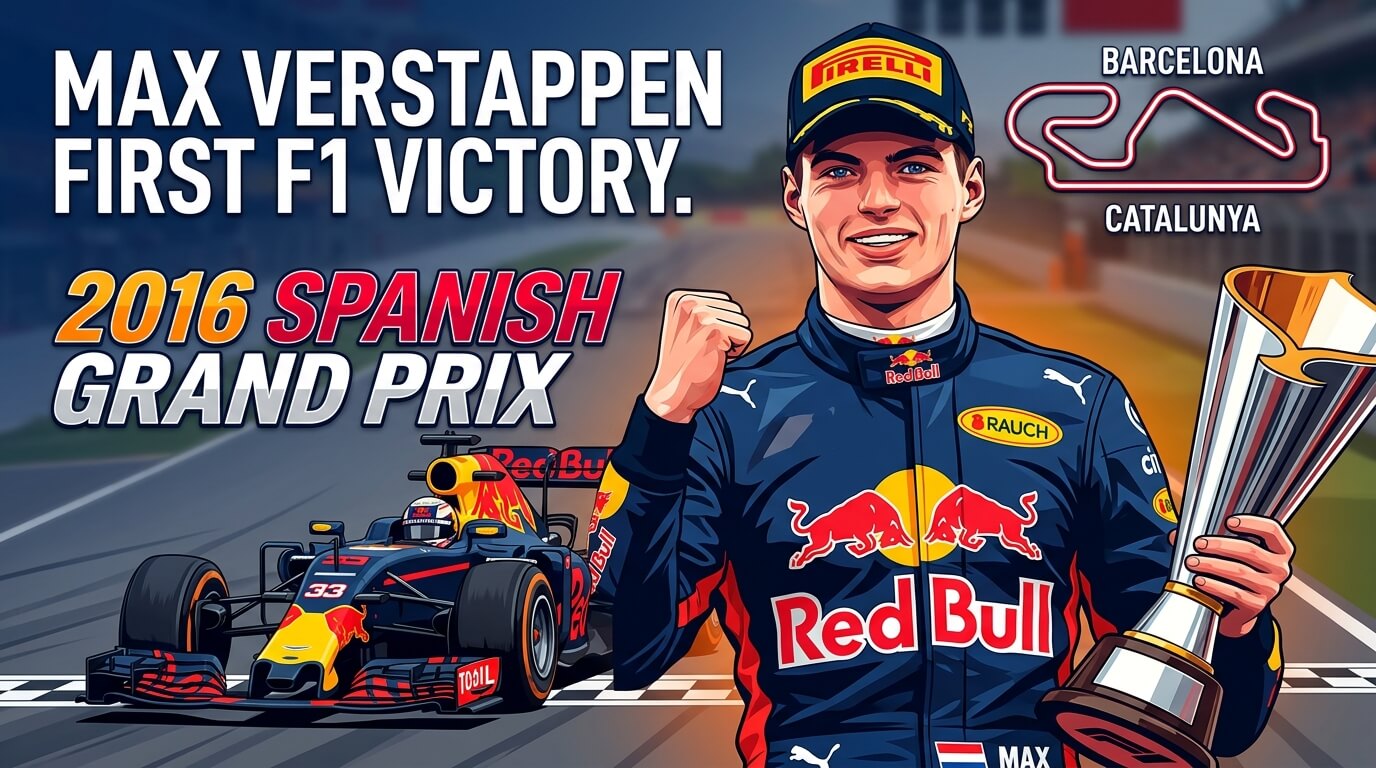

The short answer: Max Verstappen secured his first-ever Formula 1 victory at the 2016 Spanish Grand Prix at the Circuit de Barcelona-Catalunya on May 15, 2016.
At just 18 years, 227 days old, Verstappen became the youngest driver in Formula 1 history to win a Grand Prix—a record that still stands today. What made the victory even more extraordinary was that it came in his very first race for Red Bull Racing, having been promoted from Toro Rosso just days earlier.
This article breaks down exactly how the teenage sensation pulled off one of the most remarkable debut victories in F1 history, the chaos that made it possible, and why this race remains a defining moment in the sport. The 2016 Spanish GP winner announced himself to the world that day, and Formula 1 has never been the same since.
Related Reading: If you are interested in other recent F1 moments that captured the world’s attention, check out our recap of the Miami GP 2026 Safety Car model and how safety protocols continue to evolve in Formula 1.
Before diving into the drama, here are the key facts about the race where Verstappen’s maiden victory took place. The Circuit de Barcelona-Catalunya hosted the fifth round of the 2016 F1 season, and nobody predicted what was about to unfold.
| Detail | Information |
|---|---|
| Grand Prix | 2016 Spanish Grand Prix |
| Date | May 15, 2016 |
| Circuit | Circuit de Barcelona-Catalunya, Spain |
| Laps | 66 |
| Winner | Max Verstappen (Red Bull Racing) |
| Winning Age | 18 years, 227 days |
| Pole Position | Lewis Hamilton (Mercedes) |
| Starting Position | P4 (Verstappen) |
| Race Time | 1 hour, 41 minutes, 40.017 seconds |
| Position | Driver | Team | Gap to Winner |
|---|---|---|---|
| 1 | Max Verstappen | Red Bull Racing | — |
| 2 | Kimi Raikkonen | Ferrari | +0.616s |
| 3 | Sebastian Vettel | Ferrari | +5.581s |
| 4 | Daniel Ricciardo | Red Bull Racing | +43.950s |
| 5 | Valtteri Bottas | Williams | +45.271s |
| 6 | Carlos Sainz | Toro Rosso | +1m 01.395s |
| 7 | Sergio Perez | Force India | +1m 19.538s |
| 8 | Felipe Massa | Williams | +1m 20.707s |
| 9 | Jenson Button | McLaren | +1 lap |
| 10 | Daniil Kvyat | Toro Rosso | +1 lap |
The F1 Spain 2016 results showed a Red Bull 1-2-4 finish, with Verstappen leading a stunned podium. The youngest F1 winner record, previously held by Sebastian Vettel (21 years, 73 days at the 2008 Italian GP), was shattered by over two years.
No one—not even Verstappen himself—expected him to win the Spanish Grand Prix. His promotion to Red Bull had been announced just days earlier, following the demotion of Daniil Kvyat after a difficult start to the 2016 season.
Verstappen had made his F1 debut with Toro Rosso in 2015 at just 17 years old, becoming the youngest driver ever to compete in Formula 1. Across the 2015 season and the first four races of 2016, he showed flashes of brilliance but had never finished higher than 4th place.
When Red Bull decided to swap Verstappen and Kvyat ahead of the Spanish Grand Prix, the move was seen as a long-term investment—giving the teenage prodigy experience in a race-winning car. No one predicted victory in his very first outing.
In his first qualifying session for Red Bull, Verstappen immediately got up to speed. He was P3 in both Q1 and Q2, trailing only the dominant Mercedes drivers of Lewis Hamilton and Nico Rosberg. In Q3, his more experienced teammate Daniel Ricciardo edged ahead, putting the Red Bulls in P3 (Ricciardo) and P4 (Verstappen) on the grid, behind the Mercedes front-row lockout.
From that starting position, Verstappen was well-placed to capitalize on any opportunity—but no one could have imagined the opportunity that was about to present itself. The 2016 Spanish GP starting grid had Verstappen perfectly positioned to benefit from any first-lap drama.
The 2016 Spanish Grand Prix is remembered not just for Verstappen’s triumph, but for one of the most dramatic first-lap incidents in modern F1 history—a collision between Mercedes teammates Lewis Hamilton and Nico Rosberg that took both cars out of the race.
Start: Lewis Hamilton started from pole position and made a good start. But the run down to Turn 1 at Barcelona is one of the longest in F1, and Nico Rosberg—starting from P2—used Hamilton’s slipstream to sweep around the outside and take the lead.
Turn 3: As the cars blasted through the long right-hander at Turn 3, Rosberg encountered a problem. He had inadvertently left his car in an incorrect engine mode, leaving him temporarily down on power. Hamilton, sensing his teammate was vulnerable, began to close rapidly.
Turn 4: Approaching Turn 4, Hamilton saw an opportunity. “I could see he didn’t have the power,” Hamilton explained after the race. He darted to the inside of Rosberg, attempting to reclaim the lead. But Rosberg moved across to cover the inside line, closing the door.
The Impact: With Hamilton already committed and Rosberg moving across, the gap disappeared. Hamilton’s front wing made contact with Rosberg’s rear wheel, sending Hamilton onto the grass. He lost control, slid sideways, and slammed into the back of Rosberg’s car. Both Mercedes slithered into the gravel trap and out of the race.
The paddock was divided over who was at fault for the Hamilton Rosberg crash. Niki Lauda, Mercedes’ non-executive chairman, immediately blamed Hamilton, calling his move “too aggressive.” Three-time world champion Jackie Stewart agreed, suggesting Hamilton had been too desperate to win the race on the first lap.
However, Toto Wolff, Mercedes team principal, took a more measured view: “There are some people in the team with racing experience and when we looked at the incident the opinion differed between all of us. It was an incident that could’ve been avoided by both sides.”
The stewards ultimately declared it a racing incident, taking no further action against either driver.
Rosberg later revealed that his engine mode error had contributed to the crash. “I noticed the engine was down on power coming around to Turn 3 and I was in an incorrect mode,” he said. “I knew Lewis was closing in so I closed the door with a strong move and next thing I know, I was in the gravel trap.”
Regardless of blame, the result was seismic: both Mercedes cars were out on Lap 1, leaving the victory wide open for Red Bull and Ferrari. The Mercedes collision Spain 2016 remains one of the most shocking first-lap incidents in F1 history.
The Spanish GP first lap incident completely reshaped the race. What had looked like a guaranteed Mercedes 1-2 finish suddenly became a straight fight between Red Bull and Ferrari.
With both Mercedes out, the race became a 1-2 for Red Bull—Daniel Ricciardo leading Max Verstappen—with Ferrari’s Sebastian Vettel and Kimi Raikkonen in pursuit. What followed was a strategic chess match that would ultimately deliver Verstappen to the top step of the podium.
Red Bull and Ferrari both recognized that the circuit’s notorious difficulty for overtaking meant track position would be crucial. The teams made a critical decision: split their drivers’ strategies.
At the time, it seemed the three-stoppers—and particularly Ricciardo, who led early—were favored to win. Christian Horner, Red Bull team principal, admitted the team believed Vettel had the faster car in clean air.
As the race entered its final phase, the two-stoppers—Verstappen and Raikkonen—were running 1st and 2nd, having not pitted for a third time. But they faced a monumental challenge: making a set of medium tyres last for 32 laps to the finish.
Verstappen, remarkably, had not even been asked to do such long stints in junior categories.
With 20 laps remaining, Raikkonen had closed to within DRS range of Verstappen’s Red Bull, lurking just 0.5–0.6 seconds behind. The Ferrari was clearly faster, but the Circuit de Barcelona-Catalunya is notoriously difficult for overtaking.
Lap after lap, Raikkonen probed for a weakness:
This was Verstappen’s tyre management at its finest—a skill that would define his career.
With five laps remaining, Raikkonen’s tyres began to give up. The relentless pressure had taken its toll. Verstappen eased clear and crossed the finish line just 0.616 seconds ahead of the Ferrari veteran.
Behind them, the three-stoppers had failed to close the gap. Vettel finished 3rd, while Ricciardo—who suffered a puncture on the penultimate lap—held on for 4th.
As Verstappen crossed the line, the pit wall erupted. He had done the impossible: won his first race for Red Bull, on his debut, at 18 years old.
The podium was a surreal scene. Verstappen was joined by Kimi Raikkonen and Sebastian Vettel—two drivers who had raced against his father, Jos Verstappen, in the 1990s.
“Very good company on the podium,” Verstappen joked afterwards. “I mean Kimi even raced against my dad, so it’s very funny!”
The Dutch national anthem played for the first time in Formula 1 history—a moment that would become increasingly familiar in the years to come. The Verstappen vs Raikkonen battle became an instant classic.
Verstappen’s victory at the 2016 Spanish Grand Prix shattered multiple records and announced the arrival of a generational talent.
| Record | Driver | Age | Race |
|---|---|---|---|
| Previous record holder | Sebastian Vettel | 21 years, 73 days | 2008 Italian GP |
| New record holder | Max Verstappen | 18 years, 227 days | 2016 Spanish GP |
Verstappen beat Vettel’s record by an astonishing 2 years and 137 days—a margin that may never be surpassed given F1’s current minimum age requirements. The Verstappen age record remains one of the most impressive statistical achievements in motorsport history.
The F1 history records broken that day cemented Verstappen’s place in the sport’s history books.
Red Bull team principal Christian Horner was visibly emotional after the race:
“He’s his own man and a very together young guy. You’d never think he was 18. He was quick, measured and mature. He defended incredibly well against a seasoned pro like Kimi and to score his first grand prix victory, becoming the youngest victor on his debut for the team, is fairytale stuff. He’s the first driver I’ve had that legally I could be his father!”
The Red Bull debut win was a testament to the team’s young driver programme, led by Helmut Marko, which had spotted Verstappen’s talent years earlier.
One of the most enduring images from the 2016 Spanish Grand Prix was not on the track—it was in the garage, where Verstappen’s father, Jos Verstappen, a former F1 driver himself, watched his son make history.
Jos, who never won a Grand Prix in his own career, was seen dabbing his eyes with a tissue as his son crossed the finish line. His voice trembled as he spoke to Sky Sports: “It’s unbelievable, I can’t believe this.”
Speaking about his father’s reaction, Max said:
“To hear the Dutch national anthem for the first time in Formula One, I have to think about my dad for sure and I heard he was crying, so yeah it’s unbelievable. He invested a lot of time in me and this achievement is also because of him.”
The moment was a poignant passing of the torch—from a father who had raced in F1 without winning, to a son who would go on to dominate the sport. The Jos Verstappen reaction became one of the most heartwarming moments in F1 history.
Looking back from 2026, Verstappen’s victory at the 2016 Spanish Grand Prix is widely recognized as the moment the balance of power in Formula 1 began to shift.
At the time of writing, Verstappen has gone on to win multiple World Drivers’ Championships and dozens of Grands Prix. But the 2016 Spanish Grand Prix remains special—it was the first domino in a career that would redefine the sport.
The Verstappen championship career that followed included dominant seasons, intense rivalries, and records that continue to fall.
For Red Bull, the victory validated the decision to promote Verstappen so aggressively. For the rest of the grid, it was a warning: a teenager who had barely been in F1 for a year was already winning races. For F1 fans, it was the birth of a new superstar.
As Helmut Marko, head of Red Bull’s young-driver program, said: “This is just the beginning.” He was right.
Motorsport publication Autosport reflected on the victory years later:
“The longer this goes on, the more Max Verstappen looks set to become a phenomenon in Formula 1. If he continues to progress at this rate, he may come to dominate his sport in a similar fashion to the way Novak Djokovic rules tennis, Stephen Curry owns basketball, or Lionel Messi dazzles in football.”
That prediction has proven remarkably accurate. The F1 generational talent that emerged in Barcelona in 2016 has become the defining driver of his era.
Related Reading: The world of motorsport continues to evolve, and so does the automotive industry. If you are inspired by the engineering excellence of F1 cars and are considering a more practical purchase, read our guide on how to choose the right car for your needs.
So, at which Grand Prix did Max Verstappen secure his first-ever Formula 1 victory in 2016? The answer is the 2016 Spanish Grand Prix at the Circuit de Barcelona-Catalunya on May 15, 2016.
It was a victory born from chaos—a first-lap Mercedes collision that eliminated both title contenders—but sealed by a performance of extraordinary maturity from an 18-year-old in his debut race for Red Bull.
Verstappen’s tyre management under relentless pressure from Kimi Raikkonen, his perfect defensive driving on a circuit where overtaking is notoriously difficult, and his composure in the face of a faster car all pointed to a driver far beyond his years.
The fairytale win made him the youngest Grand Prix winner in history—a record he still holds today—and announced the arrival of a driver who would go on to dominate Formula 1 for years to come.
For Dutch F1 fans, it was the first time hearing their national anthem on the podium. For Jos Verstappen, it was a moment of tears and pride. For Formula 1, it was the beginning of a new era.
Related Reading: The financial side of car ownership can be just as dramatic as any race. If you have ever wondered whether you paid too much for your car, read our guide on whether you were overcharged for car finance in the UK and how to claim compensation.
Another Insight: Verstappen’s rise to fame coincided with major changes in the automotive world, including the shift to electric vehicles. For a look at the latest UK car market trends, check out our analysis of UK new car registrations June 2026.
Disclaimer: This article is for informational purposes only. Race results and records are based on official FIA data available at the time of publication. Formula 1 results may be subject to post-race amendments.
Max Verstappen won his first Formula 1 race at the 2016 Spanish Grand Prix at the Circuit de Barcelona-Catalunya on May 15, 2016.
Verstappen was 18 years, 227 days old—making him the youngest driver in F1 history to win a Grand Prix.
He was driving for Red Bull Racing. It was his very first race for the team, having been promoted from Toro Rosso just days earlier.
Lewis Hamilton and Nico Rosberg collided on the first lap at Turn 4, taking both cars out of the race and opening the door for Verstappen’s victory.
Kimi Raikkonen finished 2nd for Ferrari (+0.616s), and Sebastian Vettel finished 3rd for Ferrari (+5.581s).
He broke Sebastian Vettel’s record as the youngest F1 winner. Vettel was 21 years, 73 days old when he won the 2008 Italian GP. Verstappen was 18 years, 227 days old—over two years younger.
Yes. Verstappen became the first Dutch driver ever to win a Formula 1 Grand Prix.